IELTS Score Required to Study Abroad: Country-Wise Guide for Indian Students
Last updated: 14 November 2026 · By the UniCoach Team · Checked against official university and government sources
Short answer
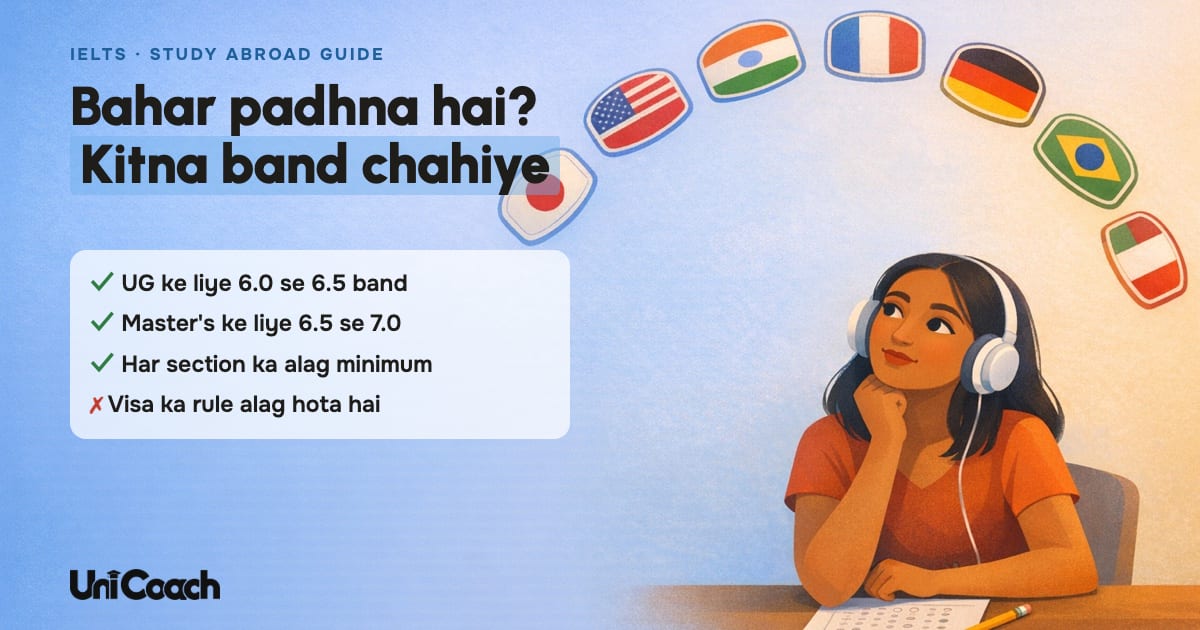
Most undergraduate courses abroad ask for IELTS 6.0 to 6.5 overall. Most master's courses ask for 6.5 to 7.0 overall. Many universities also set a minimum band in each of the four sections, usually 5.5 or 6.0, so one weak section can block an offer even when your overall band looks fine. Remember that the university rule and the visa rule are two different things. Some countries set their own English level for the student visa, and some leave it fully to the university.
Key takeaways
• There is no single worldwide IELTS score. Each university and each course sets its own number, and the course page is the only number that counts for your application.
• Band 6.0 overall opens the door, band 6.5 opens more doors. Below 6.0 your choice of courses drops sharply, especially for master's.
• Section minimums matter as much as the overall band. A 6.5 overall with 5.0 in writing is often rejected.
• Visa English rules are separate. The UK sets CEFR B2 for degree level under the Student route. Australia sets an overall band for the Subclass 500 visa. Ireland sets a low visa minimum. Canada, New Zealand, the USA and Germany leave the English test to the institution.
• Use IELTS Academic, not General Training, for university study. Several universities, including Purdue in the USA, state clearly that they do not accept General Training.
• An IELTS result is treated as valid for two years from the test date, so plan your test close to your intake, not three years early.
IELTS score required to study abroad: country-wise table
The table below separates the two rules that students mix up: what universities usually ask, and what the immigration department asks. The university number is the typical range across mainstream courses, not a promise. Competitive courses such as medicine, nursing, law, teaching and journalism almost always ask for more.
| Country | Typical undergraduate | Typical master's | Minimum in each section | Visa or immigration rule |
|---|---|---|---|---|
| United Kingdom | 6.0 to 6.5 overall | 6.5 to 7.0 overall | Usually 5.5 or 6.0 in each band | Student route needs CEFR B2 for degree level, which is IELTS for UKVI 5.5 in each of the four skills. Below degree level the rule is B1. Universities normally ask for more than the visa floor. |
| Canada | 6.0 to 6.5 overall | 6.5 to 7.0 overall | Commonly 6.0 in each band | The Student Direct Stream closed on 8 November 2024, so applications go through the regular study permit route. IRCC does not list an English test among the standard study permit documents. The college or university sets the score. |
| Australia | 6.0 to 6.5 overall | 6.5 overall and above | Commonly 6.0 in each band | Subclass 500 student visa asks for IELTS 6.0 overall. It drops to 5.5 with at least 10 weeks of packaged ELICOS or an eligible foundation or pathway program, and 5.0 with at least 20 weeks of packaged ELICOS. |
| Ireland | 6.0 to 6.5 overall | 6.5 overall and above | Commonly 5.5 or 6.0 in each band | The study visa minimum is IELTS Academic 5.0 for degree and other non-English-language courses, and 4.0 for second level, foundation or preparatory English courses. Colleges set a higher standard of their own. |
| New Zealand | 6.0 to 6.5 overall | 6.5 overall and above | Commonly 5.5 or 6.0 in each band | Immigration New Zealand does not set an IELTS score for the student visa. Your education provider confirms your English in the offer of place, so the provider's number is the one to meet. |
| United States | 6.0 to 6.5 overall | 6.5 to 7.0 overall | Commonly 6.0 in each band | There is no English test inside the F-1 student visa process. Every university sets its own score, and many will not accept IELTS General Training. |
| Germany | 6.0 to 6.5 overall for English-taught courses | 6.5 overall for most English-taught courses | Often no section minimum, but check the course | There is no English test in the student visa rules. The university decides. German-taught courses need German proof instead, usually TestDaF or DSH. |
One point students in Panipat ask us about often: a visa English floor is a floor, not a target. The UK visa floor of 5.5 in each skill does not get you into a UK university that asks for 6.5. You still have to meet the university number.
IELTS band score and what it means
IELTS reports a band from 1 to 9 for listening, reading, writing and speaking, plus an overall band. Here is what the main bands mean in plain words.
| Band | Official label | What it means in simple words |
|---|---|---|
| 9 | Expert user | Complete command of English. Accurate, fluent and fully understood. |
| 8 | Very good user | Full command with only occasional slips. Handles complex argument well. |
| 7 | Good user | Operational command. Some mistakes, but complex language and detailed reasoning are handled well. |
| 6 | Competent user | Effective command despite some mistakes. Can use fairly complex language in familiar situations. |
| 5 | Modest user | Partial command. Gets the overall meaning but makes many mistakes. |
This is why 6.0 is the usual starting line for a degree. At band 6 you can follow lectures and write assignments with some errors. At band 5 most universities feel you will struggle, so they ask you to take an English course first.
Which universities accept IELTS 6.0 or 6.5?
Below are a few real examples taken from the universities' own pages in November 2026. Treat them as examples of the pattern, not as your requirement. Entry requirements change every intake and single courses inside the same university can ask for more, so always open the course page for the exact programme you want.
| University | Country | Stated IELTS requirement |
|---|---|---|
| University of Birmingham | United Kingdom | Programme tiers start at 6.0 overall with at least 5.5 in each band, and rise through 6.5 overall to 7.0 overall with 6.5 in each band for the most demanding courses. |
| University of Toronto | Canada | 6.5 overall with no band below 6.0, all from one test date. IELTS Indicator and One Skill Retake results are not accepted. |
| RMIT University | Australia | 6.5 overall with no band below 6.0 for undergraduate and postgraduate coursework. Some programmes ask 7.0 overall with no band below 6.5. |
| Technical University of Munich | Germany | IELTS Academic 6.5 overall for English-taught programmes. IELTS Online Academic is also accepted at 6.5. |
| Purdue University | United States | 6.5 overall with at least 6.0 in each section. IELTS General Training is not accepted. |
Do you always need IELTS?
No. IELTS is the most widely accepted test, but it is not the only one. Most universities in these countries also accept PTE Academic and TOEFL iBT, and a large number now accept the Duolingo English Test, which is cheaper and faster to book. You can read how that test works in our Duolingo English Test guide.
Some universities also accept a Medium of Instruction letter from your Indian college, which states that your degree was taught and examined in English. This can work for admission at some institutions, but it is an admission concession, not a visa concession. Where the immigration department sets its own English rule, such as the UK Student route or the Australian Subclass 500 visa, an MOI letter does not replace an approved test. Check both the university page and the visa page before you decide to skip the test.
If English is your weak point, it is worth talking it through before you spend money on a test booking. Our counsellors go through your marks, your budget and your target intake first, and only then suggest the test. That conversation is part of career counselling.
How to improve your band
• Find your weakest section first. Take one full timed mock test and look at the four band scores, not the overall. Most Indian students lose marks in writing, not in reading.
• Fix writing with structure, not vocabulary. Task 1 needs an overview sentence. Task 2 needs a clear position, two developed body paragraphs and a conclusion. Long words do not raise the band if the structure is missing.
• Speak for two minutes without stopping. Record yourself on your phone daily for Part 2. Fluency carries a quarter of the speaking band.
• Practise listening at normal speed with accents you do not hear daily, including British, Australian and Canadian speakers. Never pause the audio during practice.
• Work on timing in reading. Twenty minutes per passage, no exceptions. Students lose bands because they run out of time, not because the text was hard.
• Book the test only when your mocks are steady. Two mocks at your target band, on different days, is a better signal than one lucky score.
• Check the One Skill Retake option if only one section is pulling you down. Not every university accepts it. The University of Toronto, for example, does not, so confirm before you rely on it.
Where UniCoach fits
UniCoach is a career counselling and study abroad guidance team based in Panipat, Haryana. We start with what you want to do after your degree, then work backwards to the country, the course and the English score you actually need. Many students find they were aiming at the wrong band for the wrong course.
You can shortlist courses yourself with our Course Finder and see the English requirement listed against each programme, then book a free first consultation to go through your profile with a counsellor.
Visit us: UniCoach, 1st Floor, Gali No. 4, Sahil Colony, Jattal Road, Sondhapur, Panipat 132105. Open Monday to Saturday, 10 AM to 7 PM. The first consultation is free.
FAQs
Which IELTS is required for international students? For university study you need IELTS Academic. It is designed for higher education and is the version universities ask for. IELTS General Training is built for work and migration, and many universities, including Purdue in the USA, state that they do not accept it. If your visa route needs a Secure English Language Test, such as the UK Student route, you must book IELTS for UKVI at an approved centre instead of the standard test. Can I study abroad with IELTS 6? Yes, for many courses. Band 6.0 overall is accepted for a good number of undergraduate programmes and some master's programmes in the UK, Canada, Australia, Ireland, New Zealand and the USA, and it also meets the IELTS requirement for the Australian Subclass 500 student visa. What narrows your options at 6.0 is the section minimum. Many universities ask for at least 5.5 or 6.0 in every band, so check both numbers on the course page. What IELTS score do I need for a student visa? It depends on the country, and it is usually lower than the university score. The UK Student route asks for CEFR B2 at degree level, which is IELTS for UKVI 5.5 in each of the four skills. Australia asks for IELTS 6.0 overall for the Subclass 500 visa, or 5.5 with at least 10 weeks of packaged ELICOS or an eligible pathway program. Ireland sets a visa minimum of IELTS Academic 5.0 for degree courses. Canada, New Zealand, the USA and Germany do not set an IELTS score in the visa rules and leave it to the institution. Always confirm on the official immigration website, because these rules change. Is IELTS Academic or General needed to study abroad? IELTS Academic. The Academic test uses the kind of reading and writing you meet at university, which is why admissions offices ask for it. General Training is for work, training and migration. The one thing to watch is the visa: if your route needs a Secure English Language Test, book the UKVI version of IELTS Academic at an approved test centre, because a normal IELTS Academic result will not be accepted for that visa. How long is an IELTS score valid? IELTS recommends treating a result as valid for two years from the test date, because language skills fade without use. Some organisations accept older results and some ask for a more recent one, so check the university and the immigration page. In practice, plan your test so the result is still inside two years on the day you submit your visa application, not just on the day you apply to the university. Can I study abroad without IELTS? Often yes. Most universities accept PTE Academic or TOEFL iBT instead, and many now accept the Duolingo English Test. Some also accept a Medium of Instruction letter from your Indian college if your degree was taught and examined in English. The catch is the visa. Where the immigration department sets its own English rule, as the UK and Australia do, an MOI letter will not replace an approved test. So check the university page and the visa page together before you decide to skip IELTS.Sources: GOV.UK Student visa knowledge of English guidance and Secure English Language Test (SELT) guidance; British Council IELTS for UKVI score requirements; Immigration, Refugees and Citizenship Canada (Student Direct Stream closure notice and study permit document list); Migration (English Language Tests and Evidence Exemptions for Subclass 500 (Student) Visas) Instrument 2025, in force 7 August 2025, on legislation.gov.au; Irish Immigration Service Delivery, English language requirements for study visas; Immigration New Zealand student visa guidance; ielts.org score descriptions and validity guidance; University of Birmingham, University of Toronto, RMIT University, Technical University of Munich and Purdue University English language requirement pages. This guide is general information, not legal or immigration advice. Requirements change, so check the official page before you apply.
Last updated: 14 November 2026 · By the UniCoach Team · Checked against official university and government sources
Short answer
Most undergraduate courses abroad ask for IELTS 6.0 to 6.5 overall . Most master's courses ask for 6.5 to 7.0 overall . Many universities also set a minimum band in each of the four sections , usually 5.5 or 6.0, so one weak section can block an offer even when your overall band looks fine. Remember that the university rule and the visa rule are two different things. Some countries set their own English level for the student visa, and some leave it fully to the university.
Key takeaways
• There is no single worldwide IELTS score. Each university and each course sets its own number, and the course page is the only number that counts for your application.
• Band 6.0 overall opens the door, band 6.5 opens more doors. Below 6.0 your choice of courses drops sharply, especially for master's.
• Section minimums matter as much as the overall band. A 6.5 overall with 5.0 in writing is often rejected.
• Visa English rules are separate. The UK sets CEFR B2 for degree level under the Student route. Australia sets an overall band for the Subclass 500 visa. Ireland sets a low visa minimum. Canada, New Zealand, the USA and Germany leave the English test to the institution.
• Use IELTS Academic, not General Training , for university study. Several universities, including Purdue in the USA, state clearly that they do not accept General Training.
• An IELTS result is treated as valid for two years from the test date, so plan your test close to your intake, not three years early.
IELTS score required to study abroad: country-wise table
The table below separates the two rules that students mix up: what universities usually ask, and what the immigration department asks. The university number is the typical range across mainstream courses, not a promise. Competitive courses such as medicine, nursing, law, teaching and journalism almost always ask for more.
University ranges are the common pattern across mainstream courses and are not a guarantee. Visa rules checked November 2026 against GOV.UK, IRCC, the Australian Migration (English Language Tests and Evidence Exemptions for Subclass 500 (Student) Visas) Instrument 2025, Irish Immigration Service Delivery and Immigration New Zealand. Rules change, so confirm on the official page before you book a test. Country Typical undergraduate Typical master's Minimum in each section Visa or immigration rule United Kingdom 6.0 to 6.5 overall 6.5 to 7.0 overall Usually 5.5 or 6.0 in each band Student route needs CEFR B2 for degree level, which is IELTS for UKVI 5.5 in each of the four skills. Below degree level the rule is B1. Universities normally ask for more than the visa floor. Canada 6.0 to 6.5 overall 6.5 to 7.0 overall Commonly 6.0 in each band The Student Direct Stream closed on 8 November 2024, so applications go through the regular study permit route. IRCC does not list an English test among the standard study permit documents. The college or university sets the score. Australia 6.0 to 6.5 overall 6.5 overall and above Commonly 6.0 in each band Subclass 500 student visa asks for IELTS 6.0 overall. It drops to 5.5 with at least 10 weeks of packaged ELICOS or an eligible foundation or pathway program, and 5.0 with at least 20 weeks of packaged ELICOS. Ireland 6.0 to 6.5 overall 6.5 overall and above Commonly 5.5 or 6.0 in each band The study visa minimum is IELTS Academic 5.0 for degree and other non-English-language courses, and 4.0 for second level, foundation or preparatory English courses. Colleges set a higher standard of their own. New Zealand 6.0 to 6.5 overall 6.5 overall and above Commonly 5.5 or 6.0 in each band Immigration New Zealand does not set an IELTS score for the student visa. Your education provider confirms your English in the offer of place, so the provider's number is the one to meet. United States 6.0 to 6.5 overall 6.5 to 7.0 overall Commonly 6.0 in each band There is no English test inside the F-1 student visa process. Every university sets its own score, and many will not accept IELTS General Training. Germany 6.0 to 6.5 overall for English-taught courses 6.5 overall for most English-taught courses Often no section minimum, but check the course There is no English test in the student visa rules. The university decides. German-taught courses need German proof instead, usually TestDaF or DSH.
One point students in Panipat ask us about often: a visa English floor is a floor, not a target. The UK visa floor of 5.5 in each skill does not get you into a UK university that asks for 6.5. You still have to meet the university number.
IELTS band score and what it means
IELTS reports a band from 1 to 9 for listening, reading, writing and speaking, plus an overall band. Here is what the main bands mean in plain words.
Band descriptions summarised from the official IELTS score guidance on ielts.org. Band Official label What it means in simple words 9 Expert user Complete command of English. Accurate, fluent and fully understood. 8 Very good user Full command with only occasional slips. Handles complex argument well. 7 Good user Operational command. Some mistakes, but complex language and detailed reasoning are handled well. 6 Competent user Effective command despite some mistakes. Can use fairly complex language in familiar situations. 5 Modest user Partial command. Gets the overall meaning but makes many mistakes.
This is why 6.0 is the usual starting line for a degree. At band 6 you can follow lectures and write assignments with some errors. At band 5 most universities feel you will struggle, so they ask you to take an English course first.
Which universities accept IELTS 6.0 or 6.5?
Below are a few real examples taken from the universities' own pages in November 2026. Treat them as examples of the pattern, not as your requirement. Entry requirements change every intake and single courses inside the same university can ask for more, so always open the course page for the exact programme you want.
Taken from each university's own English language requirements page, checked November 2026. Requirements change, so confirm on the course page before you apply. University Country Stated IELTS requirement University of Birmingham United Kingdom Programme tiers start at 6.0 overall with at least 5.5 in each band, and rise through 6.5 overall to 7.0 overall with 6.5 in each band for the most demanding courses. University of Toronto Canada 6.5 overall with no band below 6.0, all from one test date. IELTS Indicator and One Skill Retake results are not accepted. RMIT University Australia 6.5 overall with no band below 6.0 for undergraduate and postgraduate coursework. Some programmes ask 7.0 overall with no band below 6.5. Technical University of Munich Germany IELTS Academic 6.5 overall for English-taught programmes. IELTS Online Academic is also accepted at 6.5. Purdue University United States 6.5 overall with at least 6.0 in each section. IELTS General Training is not accepted.
Do you always need IELTS?
No. IELTS is the most widely accepted test, but it is not the only one. Most universities in these countries also accept PTE Academic and TOEFL iBT , and a large number now accept the Duolingo English Test , which is cheaper and faster to book. You can read how that test works in our Duolingo English Test guide .
Some universities also accept a Medium of Instruction letter from your Indian college, which states that your degree was taught and examined in English. This can work for admission at some institutions, but it is an admission concession, not a visa concession. Where the immigration department sets its own English rule, such as the UK Student route or the Australian Subclass 500 visa, an MOI letter does not replace an approved test. Check both the university page and the visa page before you decide to skip the test.
If English is your weak point, it is worth talking it through before you spend money on a test booking. Our counsellors go through your marks, your budget and your target intake first, and only then suggest the test. That conversation is part of career counselling .
How to improve your band
• Find your weakest section first. Take one full timed mock test and look at the four band scores, not the overall. Most Indian students lose marks in writing, not in reading.
• Fix writing with structure, not vocabulary. Task 1 needs an overview sentence. Task 2 needs a clear position, two developed body paragraphs and a conclusion. Long words do not raise the band if the structure is missing.
• Speak for two minutes without stopping. Record yourself on your phone daily for Part 2. Fluency carries a quarter of the speaking band.
• Practise listening at normal speed with accents you do not hear daily, including British, Australian and Canadian speakers. Never pause the audio during practice.
• Work on timing in reading. Twenty minutes per passage, no exceptions. Students lose bands because they run out of time, not because the text was hard.
• Book the test only when your mocks are steady. Two mocks at your target band, on different days, is a better signal than one lucky score.
• Check the One Skill Retake option if only one section is pulling you down. Not every university accepts it. The University of Toronto, for example, does not, so confirm before you rely on it.
Where UniCoach fits
UniCoach is a career counselling and study abroad guidance team based in Panipat, Haryana. We start with what you want to do after your degree, then work backwards to the country, the course and the English score you actually need. Many students find they were aiming at the wrong band for the wrong course.
You can shortlist courses yourself with our Course Finder and see the English requirement listed against each programme, then book a free first consultation to go through your profile with a counsellor.
Visit us: UniCoach, 1st Floor, Gali No. 4, Sahil Colony, Jattal Road, Sondhapur, Panipat 132105. Open Monday to Saturday, 10 AM to 7 PM. The first consultation is free.
FAQs
Sources: GOV.UK Student visa knowledge of English guidance and Secure English Language Test (SELT) guidance; British Council IELTS for UKVI score requirements; Immigration, Refugees and Citizenship Canada (Student Direct Stream closure notice and study permit document list); Migration (English Language Tests and Evidence Exemptions for Subclass 500 (Student) Visas) Instrument 2025, in force 7 August 2025, on legislation.gov.au; Irish Immigration Service Delivery, English language requirements for study visas; Immigration New Zealand student visa guidance; ielts.org score descriptions and validity guidance; University of Birmingham, University of Toronto, RMIT University, Technical University of Munich and Purdue University English language requirement pages. This guide is general information, not legal or immigration advice. Requirements change, so check the official page before you apply.