Cost of Studying Abroad for Indian Students: Country-Wise Breakdown in Rupees (2027)
Last updated: 14 November 2026 · By the UniCoach Team · Tuition and living-cost ranges checked against official government and university sources
Short answer
For a 2027 intake, the first year of studying abroad from India usually costs ₹13 lakh to ₹20 lakh in Germany, ₹21 lakh to ₹45 lakh in Ireland and New Zealand, ₹25 lakh to ₹48 lakh in Canada, ₹28 lakh to ₹65 lakh in the UK, ₹38 lakh to ₹64 lakh in Australia and ₹30 lakh to ₹75 lakh in the USA.
That total is tuition plus living cost for one year. On top of it you must also show the government a fixed amount of money before they give you the visa. All figures here are indicative and change with fees, rules and the exchange rate.
Key takeaways
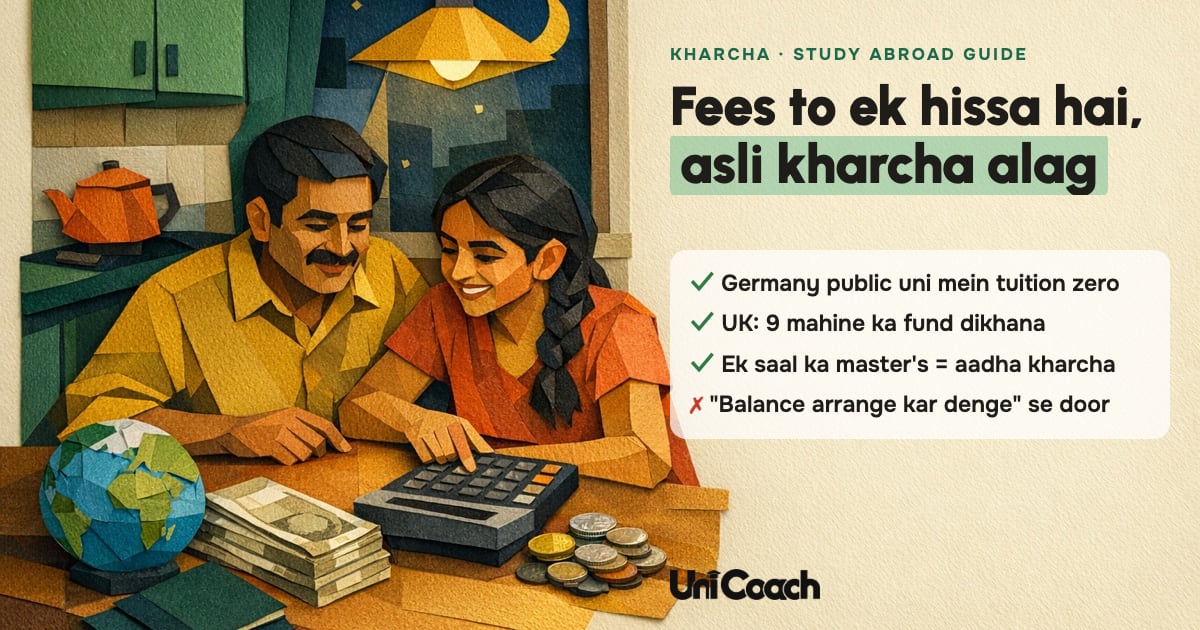
• Tuition is only part of the cost. In most countries living cost is almost as big as the fee, and in Germany it is the whole cost.
• The proof-of-funds amount is a real cost, not a formality. The government decides this number, your family has to park it in the bank or a blocked account, and the visa officer checks where it came from.
• City matters more than country. London, Sydney and Toronto cost far more than a small town in the same country. Two students in the same country can be ₹8 lakh apart.
• Germany has no tuition at most public universities, but it is not free. You still block about €11,904 in a German account before the visa, and you pay a semester contribution.
• The rupee rate changes your final number. A one rupee move in the pound changes a three-year UK budget by thousands of rupees. Budget with a buffer.
• Course length changes everything. A one-year master’s in the UK or Ireland can cost less in total than a two-year master’s somewhere cheaper per year.
Country-wise cost of studying abroad in 2027 (in rupees)
Here is the first-year picture for the seven countries Indian students ask about most. Read the ranges as a planning guide, not a quote. Rupee figures use approximate rates from 13 November 2026: £1 = ₹125, €1 = ₹104, C$1 = ₹66, A$1 = ₹64, NZ$1 = ₹52, US$1 = ₹94. The rate moves every day, so your final number will be a little different.
| Country | Tuition per year | Living cost per year | Proof of funds you must show | Rough first-year total |
|---|---|---|---|---|
| UK | £11,400 to £38,000 ₹14 lakh to ₹47 lakh | £900 to £1,400 a month ₹13.5 lakh to ₹21 lakh | £1,171 a month outside London, £1,529 in London, for up to 9 months, plus unpaid tuition | ₹28 lakh to ₹65 lakh Most students land near ₹30 lakh to ₹45 lakh |
| Canada | C$16,000 (college) to C$45,000 (university) ₹11 lakh to ₹30 lakh | C$23,000 and up ₹15 lakh to ₹18 lakh | C$23,448 living cost for one person, plus first-year tuition and travel | ₹25 lakh to ₹48 lakh |
| Australia | A$30,000 to A$65,000 ₹19 lakh to ₹42 lakh | A$29,710 is the visa minimum ₹19 lakh to ₹22 lakh | A$29,710 living cost for 12 months, plus first-year course fee and about A$2,000 travel | ₹38 lakh to ₹64 lakh |
| Ireland | €10,300 to €30,000 (medicine is far higher) ₹11 lakh to ₹31 lakh | €10,000 to €14,000 ₹10 lakh to ₹15 lakh | €10,000 for a one-year course, and the same again for each later year | ₹21 lakh to ₹45 lakh |
| Germany (public university) | No tuition at most public universities. Semester contribution €70 to €430 ₹7,000 to ₹90,000 a year | About €992 a month ₹12 lakh to ₹14 lakh | €11,904 in a blocked account (Sperrkonto) | ₹13 lakh to ₹20 lakh |
| New Zealand | NZ$20,000 to NZ$45,000 ₹10 lakh to ₹23 lakh | NZ$20,000 and up ₹10 lakh to ₹13 lakh | NZ$20,000 a year, plus tuition | ₹21 lakh to ₹38 lakh |
| USA | US$20,000 to US$60,000 ₹19 lakh to ₹56 lakh | US$12,000 to US$20,000 ₹11 lakh to ₹19 lakh | No fixed government figure. You show funds for the first year as written on your Form I-20 | ₹30 lakh to ₹75 lakh |
Compare real course fees yourself in the free Course Finder before you fix a budget. Two universities in the same city can be ₹10 lakh apart for the same subject.
Money you must show for the visa
Short answer: every country wants proof that you can pay for your first year before it gives you a visa. The amount is set by the government, not by your university or your consultant. It is real money that must sit in a bank account, a blocked account or an approved loan, and the officer will ask where it came from.
| Country | Official amount | Source or rule name |
|---|---|---|
| UK | £1,171 a month outside London and £1,529 a month in London, for up to 9 months. That is £10,539 or £13,761 (about ₹13.2 lakh or ₹17.2 lakh), plus any tuition you have not paid. The money must sit in the account for 28 days. | GOV.UK, Student visa: money you must have (maintenance funds) |
| Canada | C$23,448 for a single applicant outside Quebec, for applications made on or after 1 September 2026 (about ₹15.5 lakh). Tuition and travel are on top. | IRCC, Proof of financial support (cost-of-living figure raised again from 1 September 2026) |
| Australia | A$29,710 for 12 months of living costs (about ₹19 lakh), plus your first-year course fee and travel money, which is A$2,000 from India. Instead of savings you may show a parent or partner income of at least A$87,856 for the last 12 months. | Department of Home Affairs, Student visa subclass 500, "Have enough money for your stay" |
| Ireland | €10,000 for a course of one year or more (about ₹10.4 lakh), and evidence of the same amount for each later year. For a stay of 8 months or less it is €833 a month. If your fee is over €6,000 you must pay at least that before applying. | Immigration Service Delivery (INIS), student finance requirement in force from 30 June 2025 |
| Germany | €11,904 for one year, which is €992 a month (about ₹12.4 lakh), usually in a blocked account (Sperrkonto). You can draw only one month’s share at a time after you arrive. | Amount set by the Federal Foreign Office, published by DAAD and Study in Germany |
| New Zealand | NZ$20,000 a year for tertiary study (about ₹10.4 lakh), or NZ$1,667 a month for a shorter course. Tuition is separate. | Immigration New Zealand, student fund requirements |
| USA | No single fixed figure. Your university writes the cost of attendance on your Form I-20 and you must show funds to cover the first year of that. At a big public university this is often US$60,000 to US$70,000 (about ₹56 lakh to ₹66 lakh). | Form I-20 issued by the university under F-1 rules |
One warning. Never let anyone arrange a bank balance, a fake gap certificate or a borrowed statement for you. Visa officers check the source of funds and a fake document can get you refused and banned.
What else costs money that students forget
These are the costs that are missing from most family budgets. Together they usually add ₹2.5 lakh to ₹5 lakh in the first year.
• University application fees. Some universities charge nothing, others charge a fee for every application. If you apply to 6 places, add it up before you start.
• English test fee. IELTS in India is ₹19,000 from April 2026. PTE is in the same range. A retake means paying again, so prepare properly the first time.
• Visa fee. UK £558 (about ₹70,000). Canada C$150 plus C$85 biometrics (about ₹15,500). Australia A$2,500 from 1 July 2026 (about ₹1.6 lakh). Ireland €60 for a single entry visa. Germany €75. New Zealand from NZ$750. USA US$185 plus the US$350 SEVIS fee (about ₹50,000 together).
• Health cover. For the UK you pay the Immigration Health Surcharge of £776 for every year of your visa, upfront. For Australia you must buy OSHC for the whole visa. In Germany student health insurance is compulsory and paid monthly. In New Zealand and Ireland you need approved medical or travel insurance.
• Flights. A one-way ticket from Delhi in the August rush is the costliest time of year. Book early and keep money aside for one trip home.
• Initial setup. Rent deposit, first month’s rent, a bank account, a SIM, bedding, kitchen things and winter clothes. Most students spend ₹1 lakh to ₹2 lakh in the first six weeks.
• Biometrics trip. From Panipat that means a day in Chandigarh or New Delhi, with travel and often a hotel. Add it for every person applying.
How to bring the cost down
Scholarships and fee waivers. Most universities have merit scholarships for Indian students that cut 10 to 50 percent off tuition. They have earlier deadlines than the course itself, so apply to the university early. Our guide on how to study abroad for free lists the main funded routes.
Public universities in Germany. No tuition for most bachelor’s and master’s programmes at state universities. You pay a semester contribution of €70 to €430, which also covers your public transport pass at many universities. Baden-Württemberg is the exception: it charges non-EU students €1,500 a semester.
Work part time, but plan for zero. The current limits are 20 hours a week in term time in the UK and Ireland, 24 hours a week in Canada, 48 hours a fortnight in Australia, 25 hours a week in New Zealand, 140 full days or 280 half days a year in Germany, and on-campus work only in the first year in the USA. Part-time work covers groceries and phone bills. It will not pay your tuition, and no visa is given on that basis.
Pick a cheaper city. Manchester instead of London, Adelaide instead of Sydney, Winnipeg instead of Toronto. The degree is worth the same and rent can be half.
Count the years, not the year. A one-year master’s in the UK or Ireland means one year of tuition and one year of rent. A two-year master’s in Canada, Australia, New Zealand or the USA costs more in total even when the yearly fee looks lower. Set this against the post-study work rules of each country before you decide.
Compare before you fall in love with a name. Use the free Course Finder to put fees, course length and country side by side, and talk it through in career counselling first, because the right course decides whether the spend pays back at all.
Education loan in short
Most Indian families pay for this with a mix of savings and an education loan. Banks give unsecured loans up to a limit and ask for collateral such as property or a fixed deposit above that. The loan sanction letter is accepted as proof of funds by the UK, Canada, Australia, Ireland and New Zealand, which is why many families take the loan even when they have the cash. Interest usually starts while you study, and repayment starts after a moratorium of course length plus 6 to 12 months. Apply 3 to 4 months before your intake, because a sanction letter takes time and the visa deadline will not wait. See our education loan guide for the documents and the usual bank list.
Where UniCoach fits
UniCoach is a career counselling and study abroad guidance team in Panipat. Our office is at 1st Floor, Gali No. 4, Sahil Colony, Jattal Road, Sondhapur, Panipat 132105, open Monday to Saturday, 10 AM to 7 PM. Students and parents from Panipat, Karnal, Sonipat and nearby towns come in with a budget in mind and we work backwards from it: what that money can actually buy, in which country, for which career. The first consultation is free, online or at the office. Book a free consultation.
FAQs
How much does it cost to study abroad from India? For a 2027 intake, plan on about ₹13 lakh to ₹20 lakh for a first year in Germany at a public university, ₹21 lakh to ₹45 lakh in Ireland or New Zealand, ₹25 lakh to ₹48 lakh in Canada, ₹28 lakh to ₹65 lakh in the UK, ₹38 lakh to ₹64 lakh in Australia and ₹30 lakh to ₹75 lakh in the USA. That is tuition plus living cost. Visa fees, flights, insurance and setup costs are extra. The figures move with fees and the exchange rate. Which country is cheapest to study abroad for Indian students? Germany, if you get into a public university. There is no tuition for most bachelor’s and master’s programmes, so your main cost is living, and you must block about €11,904 for the year. New Zealand and Ireland come next on a one-year total. The cheapest option for you also depends on course length, part-time work rules and what the degree leads to. Can I study abroad with 10 lakh rupees? Ten lakh will not cover a full first year anywhere once you add the proof-of-funds amount. It can be a serious start if you win a scholarship, or if you go to a public university in Germany where there is no tuition, or if you add an education loan on top. Be careful with anyone who promises a country on a 10 lakh budget without showing you the visa funds rule. How much money do I need to show for a student visa? It depends on the country. The UK asks for £1,171 a month outside London or £1,529 in London for up to 9 months, plus unpaid tuition. Canada asks for C$23,448 for one person for applications from 1 September 2026, plus tuition and travel. Australia asks for A$29,710 of living costs plus the first-year fee and travel. Ireland asks for €10,000 a year. Germany asks for €11,904 in a blocked account. New Zealand asks for NZ$20,000 a year. The USA has no fixed figure and goes by the cost of attendance on your Form I-20. Is Germany really free for Indian students? Tuition is free at most public universities, but studying there is not free. You pay a semester contribution of €70 to €430, you must block about €11,904 for your living costs before the visa, health insurance is compulsory, and Baden-Württemberg charges non-EU students €1,500 a semester. Private universities in Germany charge full fees. Can I work while studying abroad? Yes, within limits set by each country: 20 hours a week in term time in the UK and Ireland, 24 hours a week in Canada, 48 hours a fortnight in Australia, 25 hours a week in New Zealand, and 140 full days or 280 half days a year in Germany. In the USA, F-1 students can normally work only on campus in the first year. Treat this money as pocket money for groceries and transport. Plan your tuition without it, and check the current rule on the official site because these limits change.Sources: GOV.UK Student visa (money you must have, fees, healthcare surcharge, work conditions); Immigration, Refugees and Citizenship Canada (proof of financial support, study permit fees, off-campus work); EduCanada and Statistics Canada tuition data; Australian Department of Home Affairs, Student visa subclass 500 (page updated 9 November 2026); Study Australia and Australian university 2027 fee tables; Immigration Service Delivery Ireland (student finance requirement from 30 June 2025) and Education in Ireland fee pages; DAAD and Study in Germany (blocked account amount, semester contribution, work days); Immigration New Zealand (student fund requirements, work on a student visa) and Study with New Zealand; US Department of State and ICE SEVIS fee pages, and US university cost-of-attendance pages. Rupee conversions use approximate rates from 13 November 2026. All amounts are indicative and change with fees, government rules and the exchange rate. This guide is general information, not legal, immigration or financial advice.
Last updated: 14 November 2026 · By the UniCoach Team · Tuition and living-cost ranges checked against official government and university sources
Short answer
For a 2027 intake, the first year of studying abroad from India usually costs ₹13 lakh to ₹20 lakh in Germany , ₹21 lakh to ₹45 lakh in Ireland and New Zealand , ₹25 lakh to ₹48 lakh in Canada , ₹28 lakh to ₹65 lakh in the UK , ₹38 lakh to ₹64 lakh in Australia and ₹30 lakh to ₹75 lakh in the USA .
That total is tuition plus living cost for one year. On top of it you must also show the government a fixed amount of money before they give you the visa. All figures here are indicative and change with fees, rules and the exchange rate.
Key takeaways
• Tuition is only part of the cost. In most countries living cost is almost as big as the fee, and in Germany it is the whole cost.
• The proof-of-funds amount is a real cost, not a formality. The government decides this number, your family has to park it in the bank or a blocked account, and the visa officer checks where it came from.
• City matters more than country. London, Sydney and Toronto cost far more than a small town in the same country. Two students in the same country can be ₹8 lakh apart.
• Germany has no tuition at most public universities, but it is not free. You still block about €11,904 in a German account before the visa, and you pay a semester contribution.
• The rupee rate changes your final number. A one rupee move in the pound changes a three-year UK budget by thousands of rupees. Budget with a buffer.
• Course length changes everything. A one-year master’s in the UK or Ireland can cost less in total than a two-year master’s somewhere cheaper per year.
Country-wise cost of studying abroad in 2027 (in rupees)
Here is the first-year picture for the seven countries Indian students ask about most. Read the ranges as a planning guide, not a quote. Rupee figures use approximate rates from 13 November 2026: £1 = ₹125, €1 = ₹104, C$1 = ₹66, A$1 = ₹64, NZ$1 = ₹52, US$1 = ₹94. The rate moves every day, so your final number will be a little different.
Indicative ranges only, checked in November 2026 against GOV.UK, IRCC, Australian Home Affairs, Irish Immigration Service, DAAD and Study in Germany, Immigration New Zealand, EduCanada and university fee pages. Fees, rules and exchange rates change, so confirm the numbers for your own course before you plan. Country Tuition per year Living cost per year Proof of funds you must show Rough first-year total UK £11,400 to £38,000 ₹14 lakh to ₹47 lakh £900 to £1,400 a month ₹13.5 lakh to ₹21 lakh £1,171 a month outside London, £1,529 in London, for up to 9 months, plus unpaid tuition ₹28 lakh to ₹65 lakh Most students land near ₹30 lakh to ₹45 lakh Canada C$16,000 (college) to C$45,000 (university) ₹11 lakh to ₹30 lakh C$23,000 and up ₹15 lakh to ₹18 lakh C$23,448 living cost for one person, plus first-year tuition and travel ₹25 lakh to ₹48 lakh Australia A$30,000 to A$65,000 ₹19 lakh to ₹42 lakh A$29,710 is the visa minimum ₹19 lakh to ₹22 lakh A$29,710 living cost for 12 months, plus first-year course fee and about A$2,000 travel ₹38 lakh to ₹64 lakh Ireland €10,300 to €30,000 (medicine is far higher) ₹11 lakh to ₹31 lakh €10,000 to €14,000 ₹10 lakh to ₹15 lakh €10,000 for a one-year course, and the same again for each later year ₹21 lakh to ₹45 lakh Germany (public university) No tuition at most public universities. Semester contribution €70 to €430 ₹7,000 to ₹90,000 a year About €992 a month ₹12 lakh to ₹14 lakh €11,904 in a blocked account (Sperrkonto) ₹13 lakh to ₹20 lakh New Zealand NZ$20,000 to NZ$45,000 ₹10 lakh to ₹23 lakh NZ$20,000 and up ₹10 lakh to ₹13 lakh NZ$20,000 a year, plus tuition ₹21 lakh to ₹38 lakh USA US$20,000 to US$60,000 ₹19 lakh to ₹56 lakh US$12,000 to US$20,000 ₹11 lakh to ₹19 lakh No fixed government figure. You show funds for the first year as written on your Form I-20 ₹30 lakh to ₹75 lakh
Compare real course fees yourself in the free Course Finder before you fix a budget. Two universities in the same city can be ₹10 lakh apart for the same subject.
Money you must show for the visa
Short answer: every country wants proof that you can pay for your first year before it gives you a visa. The amount is set by the government, not by your university or your consultant. It is real money that must sit in a bank account, a blocked account or an approved loan, and the officer will ask where it came from.
Checked in November 2026 from the official pages of each government. The rupee figures depend on the exchange rate on the day you show the money, so treat them as approximate. Always confirm the current amount on the official site before you block funds. Country Official amount Source or rule name UK £1,171 a month outside London and £1,529 a month in London, for up to 9 months. That is £10,539 or £13,761 (about ₹13.2 lakh or ₹17.2 lakh ), plus any tuition you have not paid. The money must sit in the account for 28 days. GOV.UK, Student visa: money you must have (maintenance funds) Canada C$23,448 for a single applicant outside Quebec, for applications made on or after 1 September 2026 (about ₹15.5 lakh ). Tuition and travel are on top. IRCC, Proof of financial support (cost-of-living figure raised again from 1 September 2026) Australia A$29,710 for 12 months of living costs (about ₹19 lakh ), plus your first-year course fee and travel money, which is A$2,000 from India. Instead of savings you may show a parent or partner income of at least A$87,856 for the last 12 months. Department of Home Affairs, Student visa subclass 500, "Have enough money for your stay" Ireland €10,000 for a course of one year or more (about ₹10.4 lakh ), and evidence of the same amount for each later year. For a stay of 8 months or less it is €833 a month. If your fee is over €6,000 you must pay at least that before applying. Immigration Service Delivery (INIS), student finance requirement in force from 30 June 2025 Germany €11,904 for one year, which is €992 a month (about ₹12.4 lakh ), usually in a blocked account (Sperrkonto). You can draw only one month’s share at a time after you arrive. Amount set by the Federal Foreign Office, published by DAAD and Study in Germany New Zealand NZ$20,000 a year for tertiary study (about ₹10.4 lakh ), or NZ$1,667 a month for a shorter course. Tuition is separate. Immigration New Zealand, student fund requirements USA No single fixed figure. Your university writes the cost of attendance on your Form I-20 and you must show funds to cover the first year of that. At a big public university this is often US$60,000 to US$70,000 (about ₹56 lakh to ₹66 lakh ). Form I-20 issued by the university under F-1 rules
One warning. Never let anyone arrange a bank balance, a fake gap certificate or a borrowed statement for you. Visa officers check the source of funds and a fake document can get you refused and banned.
What else costs money that students forget
These are the costs that are missing from most family budgets. Together they usually add ₹2.5 lakh to ₹5 lakh in the first year.
• University application fees. Some universities charge nothing, others charge a fee for every application. If you apply to 6 places, add it up before you start.
• English test fee. IELTS in India is ₹19,000 from April 2026. PTE is in the same range. A retake means paying again, so prepare properly the first time.
• Visa fee. UK £558 (about ₹70,000). Canada C$150 plus C$85 biometrics (about ₹15,500). Australia A$2,500 from 1 July 2026 (about ₹1.6 lakh). Ireland €60 for a single entry visa. Germany €75. New Zealand from NZ$750. USA US$185 plus the US$350 SEVIS fee (about ₹50,000 together).
• Health cover. For the UK you pay the Immigration Health Surcharge of £776 for every year of your visa, upfront. For Australia you must buy OSHC for the whole visa. In Germany student health insurance is compulsory and paid monthly. In New Zealand and Ireland you need approved medical or travel insurance.
• Flights. A one-way ticket from Delhi in the August rush is the costliest time of year. Book early and keep money aside for one trip home.
• Initial setup. Rent deposit, first month’s rent, a bank account, a SIM, bedding, kitchen things and winter clothes. Most students spend ₹1 lakh to ₹2 lakh in the first six weeks.
• Biometrics trip. From Panipat that means a day in Chandigarh or New Delhi, with travel and often a hotel. Add it for every person applying.
How to bring the cost down
Scholarships and fee waivers. Most universities have merit scholarships for Indian students that cut 10 to 50 percent off tuition. They have earlier deadlines than the course itself, so apply to the university early. Our guide on how to study abroad for free lists the main funded routes.
Public universities in Germany. No tuition for most bachelor’s and master’s programmes at state universities. You pay a semester contribution of €70 to €430, which also covers your public transport pass at many universities. Baden-Württemberg is the exception: it charges non-EU students €1,500 a semester.
Work part time, but plan for zero. The current limits are 20 hours a week in term time in the UK and Ireland, 24 hours a week in Canada, 48 hours a fortnight in Australia, 25 hours a week in New Zealand, 140 full days or 280 half days a year in Germany, and on-campus work only in the first year in the USA. Part-time work covers groceries and phone bills. It will not pay your tuition, and no visa is given on that basis.
Pick a cheaper city. Manchester instead of London, Adelaide instead of Sydney, Winnipeg instead of Toronto. The degree is worth the same and rent can be half.
Count the years, not the year. A one-year master’s in the UK or Ireland means one year of tuition and one year of rent. A two-year master’s in Canada, Australia, New Zealand or the USA costs more in total even when the yearly fee looks lower. Set this against the post-study work rules of each country before you decide.
Compare before you fall in love with a name. Use the free Course Finder to put fees, course length and country side by side, and talk it through in career counselling first, because the right course decides whether the spend pays back at all.
Education loan in short
Most Indian families pay for this with a mix of savings and an education loan. Banks give unsecured loans up to a limit and ask for collateral such as property or a fixed deposit above that. The loan sanction letter is accepted as proof of funds by the UK, Canada, Australia, Ireland and New Zealand, which is why many families take the loan even when they have the cash. Interest usually starts while you study, and repayment starts after a moratorium of course length plus 6 to 12 months. Apply 3 to 4 months before your intake, because a sanction letter takes time and the visa deadline will not wait. See our education loan guide for the documents and the usual bank list.
Where UniCoach fits
UniCoach is a career counselling and study abroad guidance team in Panipat. Our office is at 1st Floor, Gali No. 4, Sahil Colony, Jattal Road, Sondhapur, Panipat 132105, open Monday to Saturday, 10 AM to 7 PM. Students and parents from Panipat, Karnal, Sonipat and nearby towns come in with a budget in mind and we work backwards from it: what that money can actually buy, in which country, for which career. The first consultation is free, online or at the office. Book a free consultation .
FAQs
Sources: GOV.UK Student visa (money you must have, fees, healthcare surcharge, work conditions); Immigration, Refugees and Citizenship Canada (proof of financial support, study permit fees, off-campus work); EduCanada and Statistics Canada tuition data; Australian Department of Home Affairs, Student visa subclass 500 (page updated 9 November 2026); Study Australia and Australian university 2027 fee tables; Immigration Service Delivery Ireland (student finance requirement from 30 June 2025) and Education in Ireland fee pages; DAAD and Study in Germany (blocked account amount, semester contribution, work days); Immigration New Zealand (student fund requirements, work on a student visa) and Study with New Zealand; US Department of State and ICE SEVIS fee pages, and US university cost-of-attendance pages. Rupee conversions use approximate rates from 13 November 2026. All amounts are indicative and change with fees, government rules and the exchange rate. This guide is general information, not legal, immigration or financial advice.