Canada Student Visa (Study Permit) Guide 2026-27 for Indian Students: Requirements, PAL, Proof of Funds and PGWP
Last updated: 24 October 2026 · By the UniCoach Team · Facts checked against IRCC announcements and official sources
Key takeaways
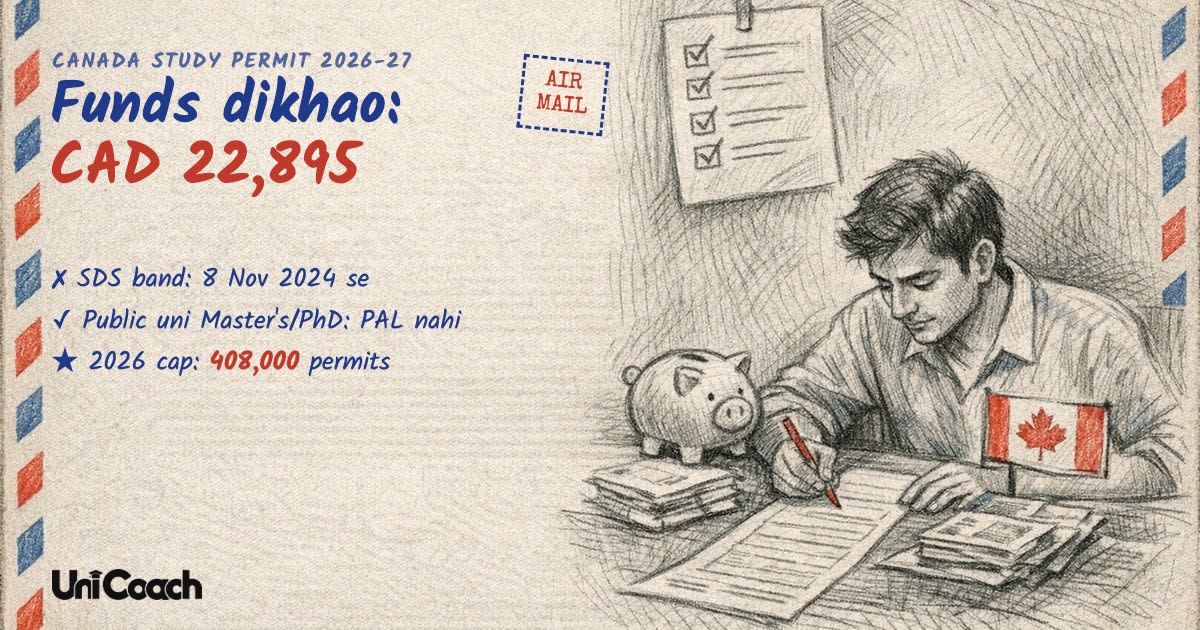
• The Student Direct Stream (SDS) ended on 8 November 2024. Indian students now apply through the regular study permit stream.
• Proof of funds is CAD 22,895 for a single applicant (applications from 1 September 2025), on top of your first-year tuition and travel costs.
• Most students need a Provincial or Territorial Attestation Letter (PAL/TAL). From 1 January 2026, master's and PhD students are exempt (reported for programmes at public institutions; confirm for your school).
• Canada set a 2026 study permit cap of 408,000 permits, about 7% lower than before.
• You can work up to 24 hours a week off campus during term, and you may qualify for a Post-Graduation Work Permit (PGWP) of up to 3 years, subject to language and field-of-study rules.
Do Indian students still have the SDS for Canada?
No. Immigration, Refugees and Citizenship Canada (IRCC) closed the Student Direct Stream on 8 November 2024. Applications received after 2:00 p.m. ET that day go through the regular study permit stream. You can still use a Guaranteed Investment Certificate (GIC) as proof of funds, but it is no longer tied to a special fast-track stream.
What are the requirements for a Canada study permit in 2026-27?
To apply for a study permit, you generally need:
• A letter of acceptance from a Designated Learning Institution (DLI).
• A PAL or TAL from the province or territory, unless you are exempt (see below).
• Proof of funds: at least CAD 22,895 for living costs for one person, plus first-year tuition and travel.
• A valid passport.
• Biometrics (fingerprints and photo).
• A medical exam, if IRCC asks for one.
• A statement of purpose / study plan explaining why you chose the course and how it fits your career.
• Language test results, if your school or programme requires them (they also matter later for the PGWP).
How much money do I need to show for a Canada study visa?
For applications from 1 September 2025, a single applicant must show CAD 22,895 for living expenses for 12 months. This is separate from tuition and travel. The amount increases with family size (for example, CAD 28,502 for two people). Students going to Quebec follow separate rules and must show funds to both Quebec's immigration ministry (MIFI) and IRCC.
Accepted proof of funds includes:
• A Guaranteed Investment Certificate (GIC) from a participating Canadian bank
• Bank statements or a Canadian bank account in your name
• An education loan sanction letter
• Scholarship or funding letters
• Receipts for tuition or housing already paid
• A letter of financial support from a sponsor, with their bank documents
Note: Canada does not use a "blocked account". That is Germany's system. In Canada, a GIC is the closest equivalent and is optional.
What is a PAL and do I need one?
A Provincial or Territorial Attestation Letter (PAL/TAL) confirms that your study permit application counts towards that province's share of Canada's study permit cap. Your college or university usually helps you get it after you accept your offer.
You generally need a PAL if you are applying for a college diploma, a bachelor's degree or most other undergraduate programmes.
You may be exempt if you are:
• A master's or PhD student applying on or after 1 January 2026 (reported for programmes at public institutions; check your school's guidance).
• Applying to extend a study permit in some cases, or in certain other categories listed by IRCC.
Always check the latest PAL rules on IRCC's website and with your school's international office, because they change often.
How many study permits will Canada issue in 2026?
Canada announced a 2026 cap of 408,000 study permits, around 7% lower than before. About 49,000 of these are allocated to master's and doctoral students, who are exempt from the PAL requirement and not counted against the processing limit for PAL-required applicants. Canada also introduced a 14-day processing standard for doctoral applicants applying from outside Canada.
Step-by-step: how to apply for a Canada study permit
1. Get accepted by a Designated Learning Institution.
2. Get your PAL/TAL, unless exempt.
3. Arrange proof of funds: CAD 22,895 plus tuition and travel. A GIC and an education loan letter are common choices for Indian students. See our education loan guide.
4. Write a clear study plan explaining your course choice, career goals and ties to India. Use our SOP guide.
5. Apply online through your IRCC account and pay the fees.
6. Give biometrics at a visa application centre and complete a medical exam if asked.
7. Wait for a decision. If approved, you receive a port of entry introduction letter and get your study permit when you land in Canada.
Can I work while studying in Canada?
Yes. Eligible students can work off campus up to 24 hours a week during regular academic terms and full time during scheduled breaks. Not every study permit allows work, so check the conditions printed on yours and the rules on the IRCC website.
Can I stay and work in Canada after graduating?
You may qualify for a Post-Graduation Work Permit (PGWP), which can last up to 3 years depending on the length of your programme. For applications from 1 November 2024:
• Language test: university graduates need CLB 7 and college graduates need CLB 5 in all four skills (reading, writing, listening and speaking). Results must be less than 2 years old.
• Field of study: degree graduates are generally exempt, but college and other non-degree programmes must be on IRCC's eligible field-of-study list.
• Private colleges: graduates of many private colleges in public-private partnership (PPP) programmes are not eligible for a PGWP.
Check your programme's PGWP eligibility before you enrol. This one check prevents the most expensive mistakes. Read more in tier-3 college abroad vs tier-1 India.
Why do Canada study permits get refused?
Common reasons include:
• Not enough proof of funds, or funds that look borrowed at the last minute.
• A weak or generic study plan that does not explain why this course and this school.
• A course that does not match your background or career goals without explanation.
• Doubts that you will leave Canada when your permit ends.
• Missing documents, such as the PAL, or inconsistent information.
Is Canada still a good option for Indian students?
Canada remains a popular choice: it had the largest number of Indian students in higher education abroad, according to Ministry of External Affairs data. But the rules are now stricter: SDS has ended, caps limit new permits, and PGWP eligibility depends on your programme and language score. Canada works best if you choose a public university or college, an eligible programme in a field with demand, and you prepare a strong application. Compare it with other countries in our Benefits of Studying Abroad guide, and see Study in Canada and the grading system in Canada.
Get help from students already in Canada
UniCoach mentors include Indian students studying in Canada who have been through the study permit process recently. Book a 1:1 session or get free counselling to check your documents before you apply.
Is SDS still available for Indian students in 2026? No. IRCC ended the Student Direct Stream on 8 November 2024. Indian students now apply through the regular study permit stream. How much bank balance is required for a Canada student visa? For applications from 1 September 2025, a single applicant must show CAD 22,895 for living costs, plus first-year tuition and travel. The amount is higher if family members come with you, and Quebec has its own requirements. Is a GIC mandatory for a Canada study permit? No. Since SDS ended, a GIC is optional. It is one accepted way to show funds, along with bank statements, education loans, scholarships and fee receipts. Do master's students need a PAL for Canada in 2026? Master's and PhD students applying on or after 1 January 2026 are exempt from the PAL requirement, as reported for programmes at public institutions. Check your school's guidance and IRCC's website for your exact case. How many hours can I work as a student in Canada? Eligible students can work off campus up to 24 hours a week during regular academic terms and full time during scheduled breaks. What IELTS score do I need for a PGWP? For PGWP applications from 1 November 2024, university graduates need CLB 7 and college graduates need CLB 5 in all four skills. Check IRCC's equivalency chart to convert CLB levels to IELTS, CELPIP, PTE Core or TEF scores.Last updated: 24 October 2026 · By the UniCoach Team · Facts checked against IRCC announcements and official sources
Key takeaways
• The Student Direct Stream (SDS) ended on 8 November 2024. Indian students now apply through the regular study permit stream .
• Proof of funds is CAD 22,895 for a single applicant (applications from 1 September 2025), on top of your first-year tuition and travel costs.
• Most students need a Provincial or Territorial Attestation Letter (PAL/TAL) . From 1 January 2026, master's and PhD students are exempt (reported for programmes at public institutions; confirm for your school).
• Canada set a 2026 study permit cap of 408,000 permits, about 7% lower than before.
• You can work up to 24 hours a week off campus during term, and you may qualify for a Post-Graduation Work Permit (PGWP) of up to 3 years , subject to language and field-of-study rules.
Do Indian students still have the SDS for Canada?
No. Immigration, Refugees and Citizenship Canada (IRCC) closed the Student Direct Stream on 8 November 2024. Applications received after 2:00 p.m. ET that day go through the regular study permit stream. You can still use a Guaranteed Investment Certificate (GIC) as proof of funds, but it is no longer tied to a special fast-track stream.
What are the requirements for a Canada study permit in 2026-27?
To apply for a study permit, you generally need:
• A letter of acceptance from a Designated Learning Institution (DLI) .
• A PAL or TAL from the province or territory, unless you are exempt (see below).
• Proof of funds : at least CAD 22,895 for living costs for one person, plus first-year tuition and travel.
• A valid passport.
• Biometrics (fingerprints and photo).
• A medical exam , if IRCC asks for one.
• A statement of purpose / study plan explaining why you chose the course and how it fits your career.
• Language test results , if your school or programme requires them (they also matter later for the PGWP).
How much money do I need to show for a Canada study visa?
For applications from 1 September 2025, a single applicant must show CAD 22,895 for living expenses for 12 months. This is separate from tuition and travel . The amount increases with family size (for example, CAD 28,502 for two people). Students going to Quebec follow separate rules and must show funds to both Quebec's immigration ministry (MIFI) and IRCC.
Accepted proof of funds includes:
• A Guaranteed Investment Certificate (GIC) from a participating Canadian bank
• Bank statements or a Canadian bank account in your name
• An education loan sanction letter
• Scholarship or funding letters
• Receipts for tuition or housing already paid
• A letter of financial support from a sponsor, with their bank documents
Note: Canada does not use a "blocked account". That is Germany's system. In Canada, a GIC is the closest equivalent and is optional.
What is a PAL and do I need one?
A Provincial or Territorial Attestation Letter (PAL/TAL) confirms that your study permit application counts towards that province's share of Canada's study permit cap. Your college or university usually helps you get it after you accept your offer.
You generally need a PAL if you are applying for a college diploma, a bachelor's degree or most other undergraduate programmes.
You may be exempt if you are:
• A master's or PhD student applying on or after 1 January 2026 (reported for programmes at public institutions; check your school's guidance).
• Applying to extend a study permit in some cases, or in certain other categories listed by IRCC.
Always check the latest PAL rules on IRCC's website and with your school's international office, because they change often.
How many study permits will Canada issue in 2026?
Canada announced a 2026 cap of 408,000 study permits , around 7% lower than before. About 49,000 of these are allocated to master's and doctoral students, who are exempt from the PAL requirement and not counted against the processing limit for PAL-required applicants. Canada also introduced a 14-day processing standard for doctoral applicants applying from outside Canada.
Step-by-step: how to apply for a Canada study permit
1. Get accepted by a Designated Learning Institution.
2. Get your PAL/TAL , unless exempt.
3. Arrange proof of funds : CAD 22,895 plus tuition and travel. A GIC and an education loan letter are common choices for Indian students. See our education loan guide .
4. Write a clear study plan explaining your course choice, career goals and ties to India. Use our SOP guide .
5. Apply online through your IRCC account and pay the fees.
6. Give biometrics at a visa application centre and complete a medical exam if asked.
7. Wait for a decision. If approved, you receive a port of entry introduction letter and get your study permit when you land in Canada.
Can I work while studying in Canada?
Yes. Eligible students can work off campus up to 24 hours a week during regular academic terms and full time during scheduled breaks . Not every study permit allows work, so check the conditions printed on yours and the rules on the IRCC website.
Can I stay and work in Canada after graduating?
You may qualify for a Post-Graduation Work Permit (PGWP) , which can last up to 3 years depending on the length of your programme. For applications from 1 November 2024 :
• Language test : university graduates need CLB 7 and college graduates need CLB 5 in all four skills (reading, writing, listening and speaking). Results must be less than 2 years old.
• Field of study : degree graduates are generally exempt, but college and other non-degree programmes must be on IRCC's eligible field-of-study list.
• Private colleges : graduates of many private colleges in public-private partnership (PPP) programmes are not eligible for a PGWP.
Check your programme's PGWP eligibility before you enrol. This one check prevents the most expensive mistakes. Read more in tier-3 college abroad vs tier-1 India .
Why do Canada study permits get refused?
Common reasons include:
• Not enough proof of funds , or funds that look borrowed at the last minute.
• A weak or generic study plan that does not explain why this course and this school.
• A course that does not match your background or career goals without explanation.
• Doubts that you will leave Canada when your permit ends.
• Missing documents , such as the PAL, or inconsistent information.
Is Canada still a good option for Indian students?
Canada remains a popular choice: it had the largest number of Indian students in higher education abroad, according to Ministry of External Affairs data. But the rules are now stricter: SDS has ended, caps limit new permits, and PGWP eligibility depends on your programme and language score. Canada works best if you choose a public university or college , an eligible programme in a field with demand, and you prepare a strong application. Compare it with other countries in our Benefits of Studying Abroad guide , and see Study in Canada and the grading system in Canada .
Get help from students already in Canada
UniCoach mentors include Indian students studying in Canada who have been through the study permit process recently. Book a 1:1 session or get free counselling to check your documents before you apply.